

 Medical oxygen concentrators were invented in the early-1970s. Manufacturing output of these devices increased in the late 1970s. Prior to that era, medical oxygen therapy required the use of heavy high pressure oxygen cylinders or small cryogenic liquid oxygen systems. Both of these delivery systems required frequent home visits by suppliers to replenish oxygen supplies. In the United States Medicare switched from fee-for-service payment to a flat monthly rate for home oxygen therapy in the mid-1980s, causing the durable medical equipment (DME) industry to rapidly embrace concentrators as a way to control costs. This reimbursement change dramatically decreased the number of primary high pressure and liquid oxygen delivery systems in use in homes in the United States at that time. Oxygen concentrators became the preferred and most common means of delivering home oxygen. The number of manufacturers entering the oxygen concentrator market increased exponentially as a result of this change.
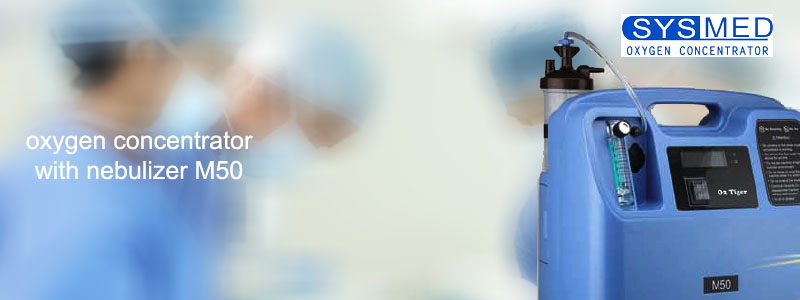
Spesification :
- Oxygen flow : 0.5 to 5 liters per minute
- Delivery Method : Continuous
- Oxygen Purity : 93 ± 3 % @5LPM and 95 ± 3 % @3LPM
- Weight : 14.2 Kg
- Dimensions : 600H, 390W, 230D(mm)
- Outlet Pressure : 0.05±0.005 Mpa
- Power : 300 watts
- Noise Level : ≤45dB
- O2 Purity Alarm : Low oxygen : 82%
- Electrical : 110V, 60 Hz/220V, 50HZ
- Additional functions : Metal connector for Fire proof
- Nebulizer Particle : ǿ 5 um
 Oxygen concentrators typically use pressure swing adsorption (PSA) technology and are used very widely for oxygen provision in healthcare applications, especially where liquid or pressurized oxygen is too dangerous or inconvenient, such as in homes or in portable clinics. For other purposes there are also concentrators based on membrane technology.
An oxygen concentrator takes in air and purifies it for use by people requiring medical oxygen due to low oxygen levels in their blood.[1] Oxygen concentrators are also used to provide an economical source of oxygen in industrial processes, where they are also known as oxygen gas generators or oxygen generation plants. Oxygen concentrators utilize a molecular sieve to adsorb gases and operate on the principle of rapid pressure swing adsorption of atmospheric nitrogenonto zeolite minerals and then venting the nitrogen. This type of adsorption system is therefore functionally a nitrogen scrubber leaving the other atmospheric gases to pass through. This leaves oxygen as the primary gas remaining. PSA technology is a reliable and economical technique for small to mid-scale oxygen generation, with cryogenic separation more suitable at higher volumes and external delivery generally more suitable for small volumes.[2]
At high pressure, the porous zeolite adsorbs large quantities of nitrogen, due to its large surface area and chemical character. After the oxygen and other free components are collected the pressure drops which allows nitrogen to desorb.
An oxygen concentrator has an air compressor, two cylinders filled with zeolite pellets, a pressure equalizing reservoir, and some valves and tubes. In the first half-cycle the first cylinder receives air from the compressor, which lasts about 3 seconds. During that time the pressure in the first cylinder rises from atmospheric to about 2.5 times normal atmospheric pressure (typically 20 psi/138 kPa gauge, or 2.36 atmospheres absolute) and the zeolite becomes saturated with nitrogen. As the first cylinder reaches near pure oxygen (there are small amounts of argon, CO2, water vapour, radon and other minor atmospheric components) in the first half-cycle, a  valve opens and the oxygen-enriched gas flows to the pressure equalizing reservoir, which connects to the patient’s oxygen hose. At the end of the first half of the cycle, there is another valve position change so that the air from the compressor is directed to the 2nd cylinder. The pressure in the first cylinder drops as the enriched oxygen moves into the reservoir, allowing the nitrogen to be desorbed back into gas. Partway through the second half of the cycle, there is another valve position change to vent the gas in the first cylinder back into the ambient atmosphere, keeping the concentration of oxygen in the pressure equalizing reservoir from falling below about 90%. The pressure in the hose delivering oxygen from the equalizing reservoir is kept steady by a pressure reducing valve.
Older units cycled with a period of about 20 seconds, and supplied up to 5 litres per minute of 90+% oxygen. Since about 1999, units capable of supplying up to 10 lpm have been available.


